
My journey out of the Apple/Google eco-systems is moving slowly, but surely.
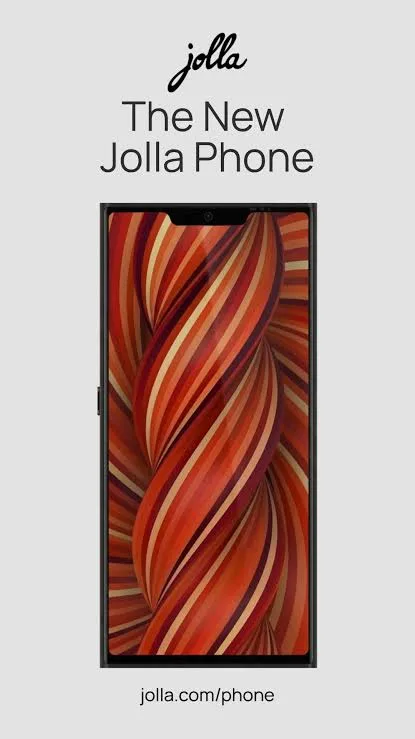
My latest move is a phone from Finland with a Linux-based operating system all its own called Sailfish OS, the phone is the Jolla Phone 2026.
Let's get something out of the way from the start: in 2026 this is a mid-range phone with an over-sized price tag and a weird operating system. In short it's an enthusiast device.
Just looking at the scale I suspect Apple sells as many iPhones in a slow hour as Jolla has sold during their entre lifetime and cycle of phones. The Jolla Phone 2026 is the third phone from them and by all accounts wildly more succesful than their previous efforts. Which for context means around 10000 sold Jolla Phone 2026.
If we get down to the nitty gritty, it's outfitted with a MediaTek Dimensity 7100 5G and 12GB of RAM and 256 GB of storage. It has room for 2 physical SIM cards and an SD card so storage can be expanded. The screen is 6.36", FullHD AMOLED, protected by Gorilla Glass and it attracts fingerprints like crazy.
On the topic of fingerprints there is a sensor built-in to the power-on button, it has physical buttons for volume up and down and a privacy button you can assign to things like turning of the mic or camera. USB-C to charge and attach peripherals (my Shanling UA7 DAC works just fine with it) rounds it out.
5G, WiFi 6 and Bluetooth 5.4 are all onboard for wireless connectivity. No wireless charging though.
Coming from the Nothing CMF Phone 2 Pro which comes with the MediaTek 7300 Pro which is also decidedly a mid-tier phone, the Jolla Phone 2026 is noticably slower. It's a subtle diffrerence in speed but it's not as slow to annoy me. To me this is an acceptable trade-off but YMMV.
For added customization the phone has something called TOH, The Other Half, which is really the back plate of the phone. If you had a Nokia dumb phone you know how easily you could remove the back on those to expose the battery. Well, that's back and there is a small connector for backplates so they could in theory do more. If you pre-ordered the Jolla Phone it included a blue backplate with an illuminating Jolla logo. CAD specifications for this has been released so one could in theory 3D print... stuff like a Qi-enabled cover.
The main reason for getting a Jolla Phone is to try to sever reliance on US brotech. Look, all phones are built in China but this one was designed, sold and assembled in Europe. Most of this we can get with a Nothing phone too which was why I first bought that. But the other side of the equation is still firmly american: Nothing OS is Android.
The Jolla Phone sports a different operating system: Sailfish OS. Like Android it is ultimately based on Linux (also a Finnish invention) but it's not a fork of Android or a fresh coat of paint for it. It's a genuine, original Linux-based operating system for phones.
Sailfish OS you say?
Just like earlier turf wars between operating systems the Jolla Phone has a rough time of it when being compared to iOS and Android. There just aren't that many apps for it. Jolla has a "fix" for this though, you can actually run Android apps on an emulation layer.
As a swede it disturbs me to no end that essential apps like BankID and Swish are completely tied to having an Apple and/or Google acoount. So far I have had great success running the android apps I just cannot live without, the 2 above and my bank app.
In short, the Android support works very well for me but I wish I didn't need it.
The Sailfish OS user interface is heavily based on gestures (duh, it's a phone) and you need to learn a fresh set of them as you undoubtedly already know iOS and/or Android ones. Muscle memory works against you but after just a few days i'm getting the hang of it and it's actually quite elegant.
I will do another write-up of the apps you can actually run on the Jolla and the trials and tribulations of installing them.